Stacklab: Financial Analysis Platform
A comprehensive financial analysis platform for stock traders with agentic AI workflows, real-time data visualisation, and portfolio management tools.
Visit site →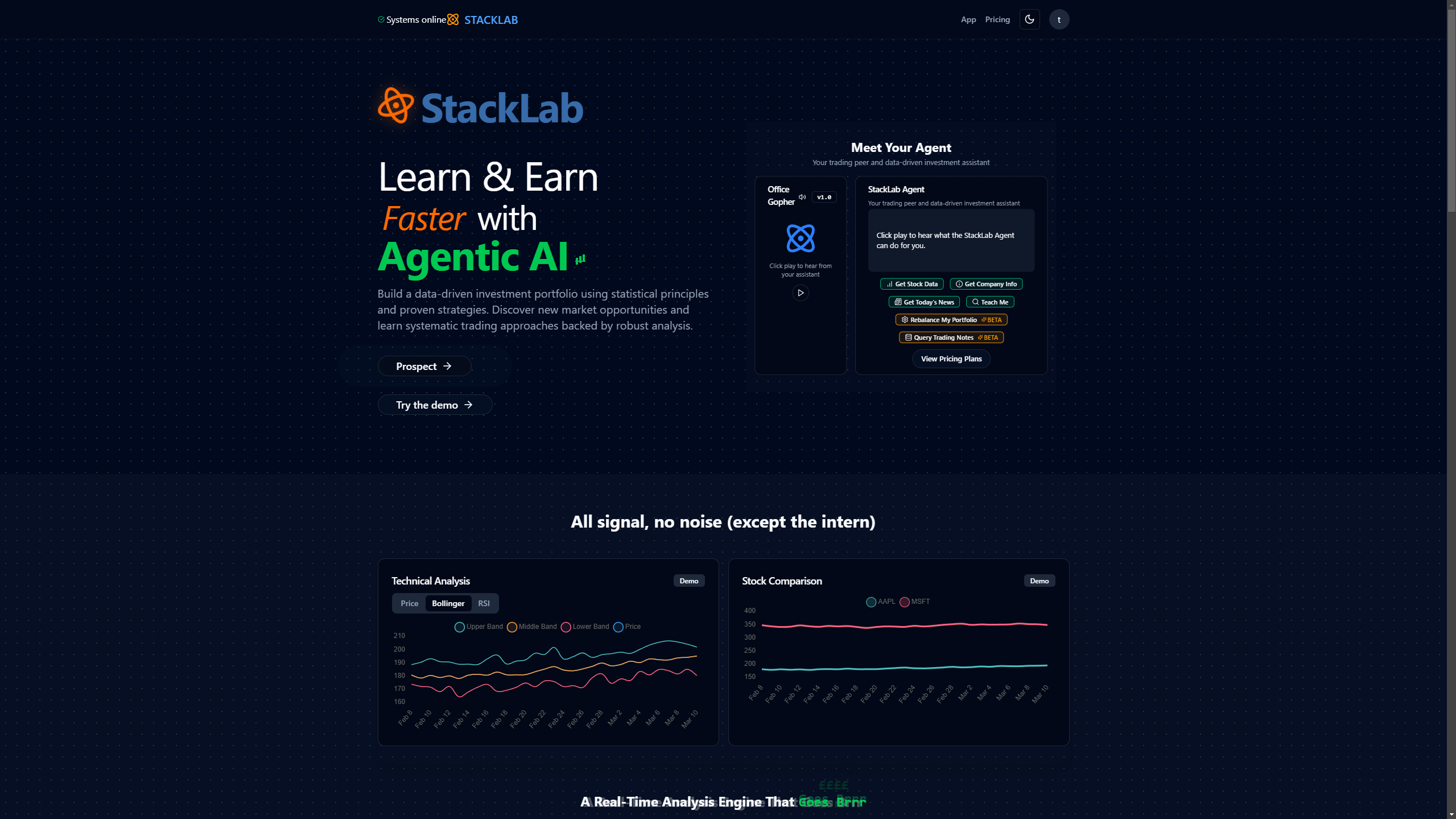
Stacklab
Project Overview
Stacklab is a sophisticated financial analysis platform I developed to help stock traders make more informed decisions, manage risk, and learn in a fun way while doing it. The dashboard combines real-time market data visualisation with AI-powered insights and portfolio management tools, all wrapped in an intuitive, subscription-based service.
The Challenge
Modern traders face information overload. They need to track multiple stocks simultaneously, analyse complex trends, and make quick decisions based on various data points. Existing solutions were either too basic for serious traders or too complex for those getting started.
The goal was to create a platform that could:
- Visualise market data in a clear, actionable way
- Provide AI-driven analysis of portfolios and trading strategies
- Scale from beginner to professional needs through tiered subscription plans
- Maintain security for sensitive financial data
Solution & Features
I built Stacklab as a comprehensive but accessible dashboard with several key components:
Interactive Market Analysis
The heart of Stacklab is its interactive charting system, which lets users visualise price movements and technical indicators and compare multiple stocks at once, working alongside its agentic workflows. Users can adjust time frames from daily to monthly views and overlay various analytical tools, accessed in conversation or via the dashboards.
AI-Powered Assistant
One of the platform’s standout features is the AI assistant that can interpret market trends, summarise financial news, and answer user questions about stocks or trading strategies. This feature uses natural language processing to make complex financial concepts more accessible. I opted for the more novel of the two approaches and went straight to voice.
Portfolio Management
Users can track their current holdings and watchlists, with the system providing optimisation suggestions through the conversational, agentic interface, along with risk assessments. The portfolio analyser helps identify underperforming assets and suggests rebalancing strategies.
Strategy Testing
For more advanced users, Stacklab includes backtesting capabilities to simulate how different trading strategies would have performed historically (currently for one year), helping traders refine their approaches before risking real capital. It covers Sharpe ratios, multicollinearity, and more, while teaching what these mean in a human-like way.
Technical Implementation
The dashboard was built with a modern tech stack focused on performance and scalability. I implemented role-based access control to ensure users could only access features appropriate to their subscription tier, with secure authentication.
For the database layer, I designed a schema that efficiently stores user details, team details, plans, portfolios, preferences, and activity logs, among others.
The frontend provides responsive visualisations that work across devices (though this is being actively improved on mobile), ensuring traders can check their portfolios via tickers which persist across sessions. I plan to improve it with a goals and budgeting section, and send alerts to users in response to news or other triggers.
My Hopes
I hope Stacklab will improve how novice traders interact with market data and offer a new medium to access usually complex ideas and data.
- Reduced analysis time from hours to minutes through intuitive visualisations
- Increased confidence in trading decisions with AI-powered second opinions and a friendly (and a bit cheeky) companion
- Provided education through contextual explanations of technical indicators
- Created a clear upgrade path for users as their trading sophistication grows
What I Learnt
This project deepened my expertise in:
- Building secure, scalable financial applications
- Implementing tiered access control systems
- Integrating third-party financial data APIs
- Creating intuitive data visualisations for complex information
- Developing subscription management systems with proper payment handling
Most importantly, I learned how to balance feature complexity with usability to create tools that genuinely improve users’ financial decision-making capabilities.